MDNHA, Delta Center honor Black History Month with Delta Jewels partners

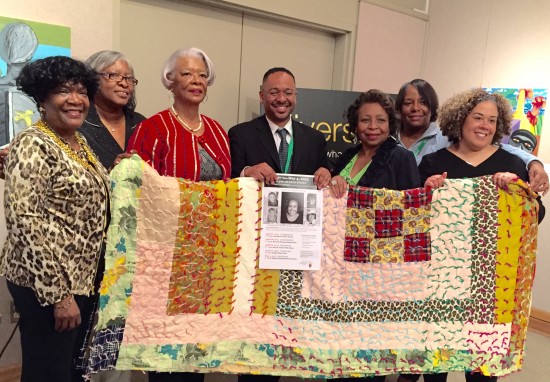
Delta Jewels with Alysia Burton Steele, Dr. Rolando Herts, and Jacqueline Dace, former project manager of the Mississippi Civil Rights Museum at the 2015 Winning the Race conference. The Delta Jewels oral history partnership program will return to D…

Delta Jewels with Alysia Burton Steele, Dr. Rolando Herts, and Jacqueline Dace, former project manager of the Mississippi Civil Rights Museum at the 2015 Winning the Race conference. The Delta Jewels oral history partnership program will return to Delta State on Wednesday, February 17.

The Mississippi Delta National Heritage Area’s Delta Jewels Oral History Partnership has yielded a series of events promoting oral history education and awareness. These events have commemorated the 2016 National Park Service Centennial, which aims to engage diverse communities and develop lifelong connections with the public, especially youth.

The MDNHA continues its celebration of the NPS Centennial through the Delta Jewels Oral History Partnership. In February, the MDNHA is presenting the following oral history partnership programs in honor of Black History Month:

 Wednesday, February 17, hosted by the Diversity Committee at Delta State University

 Thursday, February 25, hosted by the Southern Cultural Heritage Foundation in Vicksburg

 Friday, February 26, hosted by the Alcorn State University Wesley Foundation to be held in Norman

The Delta Jewels Oral History Partnership was formed in 2015 and features “Delta Jewels: In Search of My Grandmother’s Wisdom,” a collection of oral histories and photographs of African American church mothers from the Mississippi Delta by Pulitzer Prize-winning photojournalism professor Alysia Burton Steele from the University of Mississippi. Since that time, Delta Jewels has been entered into the Library of Congress.

Steele also has been selected to receive the Preserver of Mississippi Culture Award from the Mississippi Humanities Council on Friday, February 12 at the Old Capitol Museum in Jackson. Dr. Rolando Herts, director of the MDNHA and The Delta Center for Culture and Learning, nominated Steele for the award.

“I am so grateful that the Mississippi Delta National Heritage Area, The Delta Center, and the Mississippi Humanities Council see the importance of this work,” said Steele. “I partnered with the MDNHA to share oral histories throughout the state. This has helped spread the message that all of our elders – regardless of race, place, or gender – have voices and stories that need to be heard and collected by the next generation. By doing this, we all can be preservers of Mississippi culture.”

The partnership has engaged over 500 Delta residents and visitors through community gatherings in Clarksdale, Charleston, Indianola, Yazoo City, Ruleville, and Mound Bayou, as well as Mississippi Valley State University in Itta Bena. Another program was held recently at Jackson State University in collaboration with the Fannie Lou Hamer Institute @ COFO and the Margaret Walker Center.

“We are very pleased that there is ongoing demand for the Delta Jewels oral history programs,” said Herts. “Based on the positive feedback that we have received so far, it is clear that these programs have tremendous educational and cultural value that resonate with communities in and outside of the Delta region.”

Stacey Massey, Executive Director of the Southern Cultural Heritage Foundation, is excited about hosting a Delta Jewels program in Vicksburg.

“The Southern Cultural Heritage Foundation is thrilled to play host to the Delta Jewels Oral History Partnership,” said Massey. “We are honored to provide a space where these oral histories and portraits will be shared with those in the Vicksburg community.”

This will be the second time that a Delta Jewels program has been presented at Delta State and the first time at Alcorn State. Alcorn State is the oldest public historically black land-grant institution in the United States and is included on the board of the Mississippi Delta National Heritage Area.

To learn more about hosting a Delta Jewels Oral History Partnership, contact Rolando Herts at rherts@deltastate.edu, or call The Delta Center at 662-846-4311.

The MDNHA is a partnership between the people of the Mississippi Delta and the National Park Service. The area was designated by U.S. Congress in 2009 and is governed by a board of directors representing agencies and organizations defined in the congressional legislation. More information about the MDNHA, including the complete approved management plan, is available at www.msdeltaheritage.com.

The mission of The Delta Center is to promote greater understanding of Mississippi Delta culture and history and its significance to the world through education, partnerships and community engagement. The Delta Center serves as the management entity of the MDNHA and is the home of the International Delta Blues Project. For more information, visit http://www.deltastate.edu/academics/delta-center-for-culture-and-learning/.

Print Friendly and PDF

National Park Travelers Club members visit The Delta Center

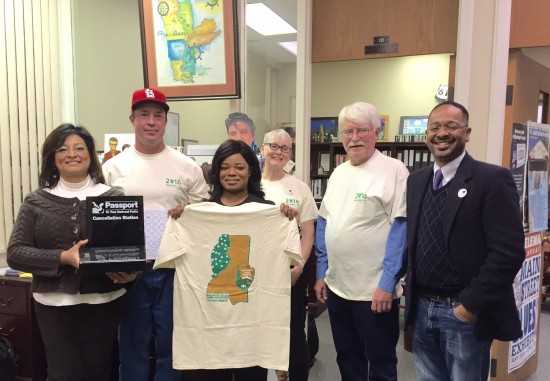
The Delta Center staff members recently greeted National Park Travelers Club members with MDNHA National Park Service Centennial passport t-shirts. Pictured are (l to r): Delta Center grad assistant Lydia Haley, David Kroese, Delta Center grad assis…

The Delta Center staff members recently greeted National Park Travelers Club members with MDNHA National Park Service Centennial passport t-shirts. Pictured are (l to r): Delta Center grad assistant Lydia Haley, David Kroese, Delta Center grad assistant Stephanie Green, Deborah Archer, Leland Warzala, and Dr. Rolando Herts, director of The Delta Center

Members of the National Park Travelers Club visited The Delta Center for Culture and Learning on the campus of Delta State this week. The group is touring the Mississippi Delta National Heritage Area collecting National Park Service passport stamps as a way to celebrate the 2016 National Park Service Centennial.

Leland Warzala (Springfield, Illinois), Deborah Archer (Norfolk, Viginia) and David Kroese (Loves Park, Illinois), visited the center to collect their MDNHA passport stamp, which is part of the NPS’ Passport to Your National Parks program. The three NPS passport enthusiasts have been traveling the MDNHA this month collecting stamps in each Delta county. Their Delta traveling adventure has yielded a series of interesting discoveries and pleasant surprises.

The travelers visited cultural heritage attractions throughout the region where passport stations are located, including the Gateway to the Blues Museum and Visitor Center in Tunica and Tallahatchie County Courthouse where the Emmett Till trial took place in 1955.

“Last night, each of us stayed in separate hotels in Clarksdale, just to get a sense of the different hotel options there,” said Archer. “We have been eating at different restaurants, too. Delta food is so delicious. We are working our way to Yazoo City next where we will stay tonight.”

While visiting The Delta Center, they learned about the internationally renowned rural juke joint Po’ Monkey’s Lounge in Merigold, an easy stop on the way to Rosedale, where the Bolivar County passport stamp is available in the Chancery Clerk’s office at the county courthouse.

They also learned about the MDNHA’s NPS centennial passport t-shirt. This collector’s item is awarded to travelers who gather all passport stamps in the MDNHA. Currently, there are 22 passport stamps across the region. This number is expected to grow as the MDNHA passport program continues to gain momentum.

Warzala gave kudos to the MDNHA and The Delta Center for managing a well organized and geographically diverse passport program.

“We would not have known about all of the interesting places to visit in the Delta had it not been for this program,” said Warzala. “We knew that we had to visit all of the counties here, because we wanted to get all of the stamps. We had no idea that there are so many great things to see and do along the way, like the Crossroads sign [in Clarksdale], Dockery Farms and all of the Blues Trail markers.”

The MDNHA launched its participation in the Passport to Your National Parks program in November 2014 with the goal of making passport stations available in each of the MDNHA’s 18 counties. By the spring of 2015, this goal was accomplished. Since then, additional regional partners in Washington and Coahoma counties have signed on to host passport stations, including the Delta Blues Museum in Clarksdale, and the Jim Henson Museum of the Frog and the Highway 61 Blues Museum, both in Leland. The full list of MDNHA passport locations is available athttp://www.msdeltaheritage.com/.

Kroese praised the state of Mississippi for supporting National Heritage Areas.

Lee Aylward (left) of The Delta Center speaks with National Park Travelers Club visitors about Mississippi Delta attractions.

Lee Aylward (left) of The Delta Center speaks with National Park Travelers Club visitors about Mississippi Delta attractions.

“There is no other state where you will find three distinct National Heritage Areas that offer such rich cultural heritage resources,” he said. “As a passport collector, I have traveled to national parks all over the country. What you have here in Mississippi with the Delta, Hills and Gulf Coast heritage areas is a real treasure. They are connected and tell great stories about music, food, literature and people.”

The travel companions plan to encourage other National Park Travelers Club members to visit the Mississippi Delta, as well as the Mississippi Hills and Gulf Coast National Heritage Areas. They also look forward to returning to Cleveland and Delta State after GRAMMY Museum Mississippi opens.

Warzala said, “The Beatles is the first exhibit that will be shown at the GRAMMY Museum? I am definitely coming back.”

Mississippi Delta-based municipalities, businesses, cultural attractions, heritage sites or other organizations that are interested in participating in the Passport Program should contact The Delta Center regarding the application process. For more information, call 662-846-4311 or email Heather Miller at hmiller@deltastate.edu.

To learn more about the National Park Travelers Club, visit http://www.parkstamps.org. To learn more about the NPS Centennial, visit www.nps.gov/2016.

The mission of The Delta Center is to promote greater understanding of Mississippi Delta culture and history and its significance to the world through education, partnerships and community engagement. The Delta Center serves as the management entity of the MDNHA and is the home of the National Endowment for the Humanities “Most Southern Place on Earth” workshop and the International Delta Blues Project. For more information, visithttp://www.deltastate.edu/academics/delta-center-for-culture-and-learning/.

The Mississippi Delta National Heritage Area is a partnership between the people of the Mississippi Delta and the NPS. The MDNHA was designated by U.S. Congress in 2009 and is governed by a board of directors representing agencies and organizations defined in the congressional legislation. More information about the MDNHA, including the complete approved management plan, is available at http://www.msdeltaheritage.com.

Print Friendly and PDF

Delta Center presents at national conference for social studies educators

The staff of The Delta Center for Culture and Learning at Delta State recently presented at the National Association of Social Studies Teachers’ annual meeting in New Orleans, Louisiana. The presentation, “Transforming Classrooms Through Experiences in the Mississippi Delta,” highlighted The Delta Center’s National Endowment for the Humanities workshop “The Most Southern Place on Earth, the Music, Culture and History of the Mississippi Delta.”

The conference was attended by social studies teachers from across the country. The presentation was organized and planned by two former “Most Southern” workshop participants Heidi Imhof and Kelly Scallion, both high school history teachers from Fairbanks, Alaska. The duo participated in the 2010 workshop.

“We wanted this presentation to serve as a way to repay The Delta Center for all that was shared with us and to document how that information continues to be shared with our students and communities all across the United States,” said Imhof.

“We cannot begin to tell you how much the Delta means to us,” added Scallion. “This was the least we could do to show our appreciation for opening a new chapter in each of our lives.”

Imhof and Scallion served as moderators for the presentation. In addition to an overview of the workshop provided by TDC staff, the presentation featured 10 additional former workshop participants from Buffalo, New York, Phoenix, Arizona, Columbus, Ohio, Tennessee, as well as two Mississippi teachers from Jackson and Columbus. These presenters discussed Delta cultural heritage educational topics used in their classrooms, including Emmett Till, Freedom Summer and blues music.

Presentation attendees were treated to Delta Blues music selections, as well as tastes of hot tamales and koolickles, which are celebrated Delta food delicacies. The moderators also gave special thanks to members of TDC staff who facilitated the 2010 workshop, including Dr. Luther Brown, Dr. Henry Outlaw, Lee Aylward and Heather Miller.

TDC is preparing to host its seventh year of the workshop in the summer of 2016. Applications are currently being accepted for the 2016 workshop. For more information, visit http://deltacenterdsu.com/mostsouthern/.

The mission of The Delta Center is to promote greater understanding of Mississippi Delta culture and history and its significance to the world through education, partnerships and community engagement. The center serves as the management entity of the Mississippi Delta National Heritage Area and is the home of the National Endowment for the Humanities “Most Southern Place on Earth” workshop and the International Delta Blues Project. For more information, visit http://www.deltastate.edu/academics/delta-center-for-culture-and-learning/.

Print Friendly and PDF

Herts selected for Delta Leadership Institute Executive Academy

Dr. Rolando Herts, director of The Delta Center for Culture and Learning, will take part in the year-long Delta Leadership Institute Executive Academy.

Dr. Rolando Herts, director of The Delta Center for Culture and Learning, will take part in the year-long Delta Leadership Institute Executive Academy.

The Delta Regional Authority recently announced 52 community leaders for an intensive year-long leadership training program across the Delta region known as the Delta Leadership Institute Executive Academy. Dr. Rolando Herts, director of the Delta Center for Culture and Learning at Delta State University, will participate as a fellow in the program’s 11th year.

Herts will join other DLI fellows from each of the eight Delta region states. Participants are nominated by their respective governors to participate in the year-long leadership training program.

“Our communities and region need strong local leadership to continue to grow and thrive. This is why DRA has made investing in our leaders a priority,” said Chris Masingill, federal co-chairman of the DRA. “I’m very proud of this class and what they have already accomplished in their own communities. DLI will only further prepare them to continue to lead.”

Over the course of the Executive Academy year, Herts will attend six sessions across the Delta region and in Washington, D.C. to engage in advocacy training, case study discussion, and on-the-ground field studies of priority issue areas for the region, including Workforce Training and Education, Small Business and Entrepreneurship, Public Health, Transportation and Basic Public Infrastructure.

“I believe that it is my life purpose to continue to help improve quality of life in the Delta region through education and community and economic partnership development,” said Herts. “Becoming part of the Delta Leadership Institute will equip me with social and intellectual capital resources to serve our region more effectively and with greater impact.”

Since 2005, the DLI has worked to improve the decisions made by community leaders across the Delta by broadening their understanding of regional issues, building a corps of alumni that have a regional and national perspective, developing a toolkit of resources for addressing issues facing their local communities, and providing the training and professional development needed to extend the pipeline of skilled local leadership within Delta communities.

The newest DLI class is holding orientation this week and its first session of the academy in Memphis, Tenn.

The Delta Regional Authority is a federal-state partnership created by Congress in 2000 to help create jobs, build communities, and improve lives through strategic investments in economic development in 252 counties and parishes across eight states. Through the Rural Communities Advancement Program, the DRA has provided leadership development to more than 400 community leaders over 10 years and strengthened regional collaboration with its Delta Leadership Institute.

The DRA partners with Arkansas State University, the University of Alabama, and the University of Louisiana at Monroe for programming and organizational support of the institute. Learn more about the Delta Leadership Institute at dra.gov/leadership.

“The Delta region has been with me throughout my personal and professional life,” added Herts. “I am passionate about improving quality of life here through cultural heritage education, tourism and partnership development. I believe that the academy will empower me and others to accomplish this more effectively through collaboration.”

Print Friendly and PDF

MDNHA, Delta Center announce Delta Jewels oral history partnership

Alysia Burton Steele, center, with Delta Jewels church mothers at a Delta Jewels Community Gathering in Yazoo City. Mississippi Valley State University will host the inaugural Delta Jewels Oral History Partnership program on Oct. 29 as part of the u…

Alysia Burton Steele, center, with Delta Jewels church mothers at a Delta Jewels Community Gathering in Yazoo City. Mississippi Valley State University will host the inaugural Delta Jewels Oral History Partnership program on Oct. 29 as part of the university’s Zelma T. Howard Lecture Series.

The Mississippi Delta National Heritage Area recently forged the “Delta Jewels Oral History Partnership” with Alysia Burton Steele, Pulitzer Prize-winning journalism professor at the University of Mississippi. Steele is the author of “Delta Jewels: In Search of My Grandmother’s Wisdom,” a book of oral histories and portraits of over 50 African American church mothers from the Mississippi Delta, including civil rights icon Myrlie Evers-Williams. The book has received national media coverage, including The New York Times, NBC, National Public Radio, USA Today, Chicago Sun-Times, Southern Living, Essence and The Atlanta Journal-Constitution.

The partnership will provide opportunities for MDNHA and The Delta Center for Culture and Learning at Delta State University to present oral history programs and workshops with regional, statewide and national organizations. The partnership is designed to make oral history education and awareness accessible to diverse communities, as well as to promote Mississippi Delta culture and history on a broader scale.

Mississippi Valley State University in Itta Bena, Miss. will be the first organization to host an oral history program under this new partnership.

“Mississippi Valley State University is honored to host the inaugural program for the Delta Jewels Oral History Partnership,” said La Shon Brooks, Chief of Staff at MVSU. “Providing a space where these culturally enriching oral histories will be shared with our students, faculty, staff and community members aligns with the public education mission of our institution.”

MVSU’s oral history program is part of the Zelma T. Howard Lecture Series sponsored by the university’s Department of English. The presentation will take place at the William W. Sutton Administration Building, Auditorium 103, on Oct. 29 at 10 a.m. The event is free and open to the public.

The MDNHA and The Delta Center partnered with Steele earlier this year to host a series of Delta Jewels community gatherings aimed at promoting cultural heritage and oral history awareness. The events took place in several Delta communities including Clarksdale, Charleston, Indianola, Yazoo City, Ruleville and Mound Bayou. The Mound Bayou gathering was hosted in conjunction with the city’s 128th anniversary celebration in July.

The gatherings attracted over 500 guests from throughout the Mississippi Delta region and the nation. Steele and the Delta Jewels also presented sessions at Delta State University’s Winning the Race conference. Continued demand for these presentations led to the creation of the Delta Jewels Oral History Partnership.

“This new partnership will help the MDNHA to fulfill various aspects of its management plan approved by the National Park Service, including oral history education, promoting Delta culture and history, and telling Delta stories,” said Dr. Rolando Herts, director of the MDNHA and The Delta Center. “The partnership also serves as a vehicle for the MDNHA to offer expanded Delta Jewels programming in the Mississippi Delta and beyond.”

“I am excited about this partnership, and I believe we will reach diverse groups of people,” said Steele. “These presentations and the book’s contents transcend race, age, class, gender and geography. I have received messages from readers in Italy, France, New Zealand and Australia. I believe everyone can relate to having a special elder in their lives and I want to inspire people – all people – to record their family history.”

To learn more about hosting a Delta Jewels oral history program or workshop, contact Herts at rherts@deltastate.edu, or call The Delta Center at 662-846-4311.

The MDNHA is a partnership between the people of the Mississippi Delta and the National Park Service. The area was designated by U.S. Congress in 2009 and is governed by a board of directors representing agencies and organizations defined in the congressional legislation. More information about the MDNHA, including the complete approved management plan, is available at www.msdeltaheritage.com.

Print Friendly and PDF

Pictures from Monday’s blues conference events

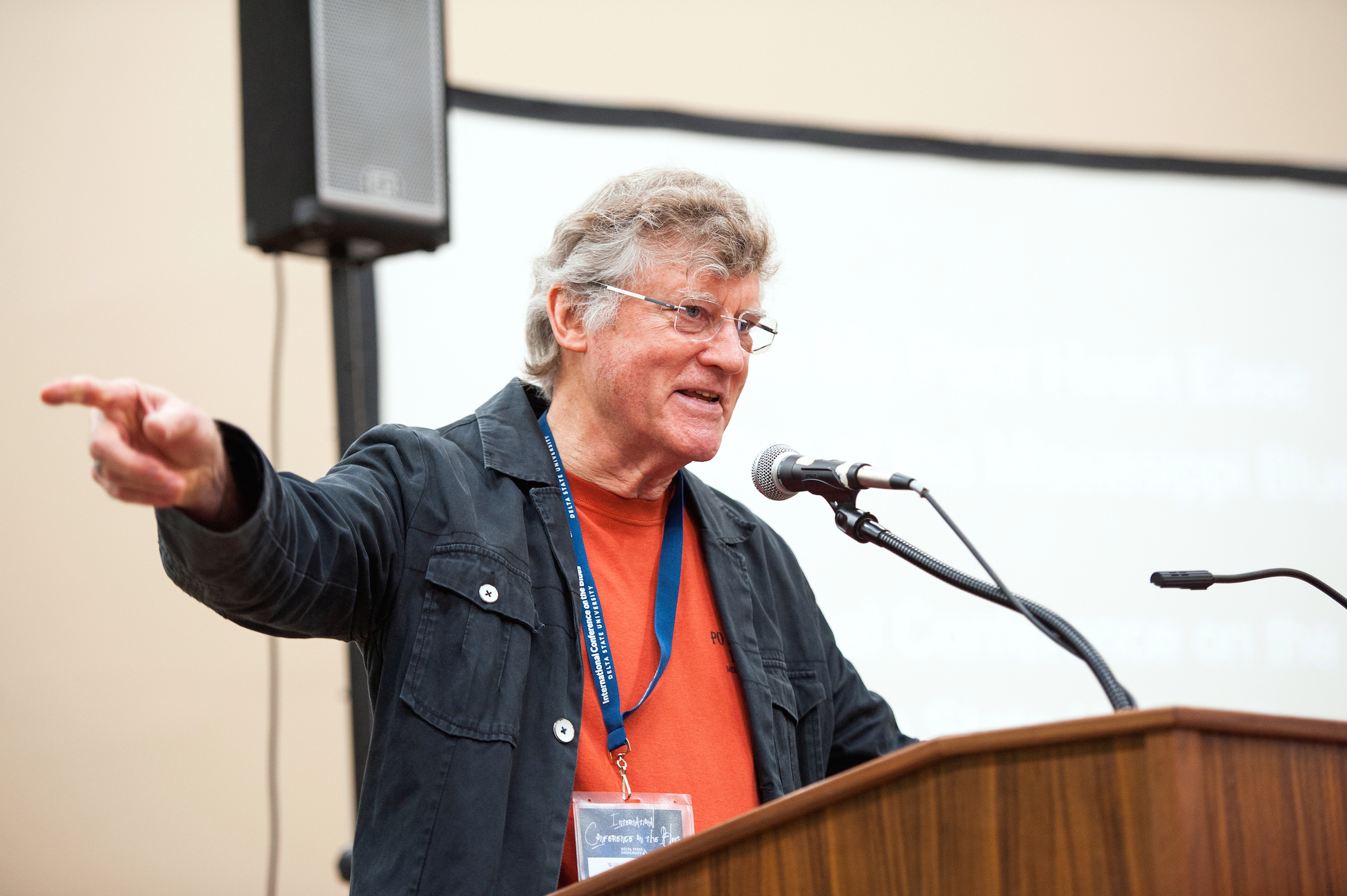
Dr. William Ferris, a widely recognized leader in Southern studies, African American music, and folklore, delivers the keynote address at the second annual International Conference on the Blues Monday at Delta State University. Ferris the Joel R. Wi…

Dr. William Ferris, a widely recognized leader in Southern studies, African American music, and folklore, delivers the keynote address at the second annual International Conference on the Blues Monday at Delta State University. Ferris the Joel R. Williamson Eminent Professor of History at the University of North Carolina at Chapel Hill and the senior associate director of UNC’s Center for the Study of the American South. He is also adjunct professor in the curriculum on folklore. The conference continues Tuesday, ending with a free concert featuring Bobby Rush and James “Super Chikan” Johnson. For more information, visit www.deltastate.edu/blues. Photos by Rory Doyle.

GRAMMY winner Dom Flemons (right) and Don Allan Mitchell, co-chair of the International Conference on the Blues, during one of the conference sessions on Monday. Flemons is the “American Songster,” pulling from traditions of old-time folk music to c…

GRAMMY winner Dom Flemons (right) and Don Allan Mitchell, co-chair of the International Conference on the Blues, during one of the conference sessions on Monday. Flemons is the “American Songster,” pulling from traditions of old-time folk music to create new sounds. Having performed music professionally since 2005, he has played live for over one million people within the past three years. As part of the Carolina Chocolate Drops, which he co-founded with Rhiannon Giddens and Justin Robinson, he has played at a variety of festivals, spanning from the Newport Folk Festival to Bonnaroo, in addition to renowned venues such as the Grand Ole Opry. The International Conference on the Blues continues Tuesday. For more information, visit www.deltastate.edu/blues. Photos by Rory Doyle.

Print Friendly and PDF

Stolle to present blues lecture in Clarksdale

Roger Stolle will present a lecture on blues entrepreneurship and the Mississippi Delta’s creative economy as part of Delta State University’s International Conference on the Blues Oct. 1 at 5:30 p.m. at the Coahoma County Higher Education Center.

Roger Stolle will present a lecture on blues entrepreneurship and the Mississippi Delta’s creative economy as part of Delta State University’s International Conference on the Blues Oct. 1 at 5:30 p.m. at the Coahoma County Higher Education Center.

Roger Stolle, owner of Cat Head Delta Blues & Folk Art in Clarksdale, Miss,, will present a lecture on blues entrepreneurship and the Mississippi Delta’s creative economy as part of Delta State University’s International Conference on the Blues.

The pre-conference lecture event will take place Oct. 1 at 5:30 p.m. at the Coahoma County Higher Education Center, a Delta State satellite campus located at 109 Clark St. in Clarksdale. The lecture is free and open to the public through a partnership between CCHEC and The Delta Center for Culture and Learning, which is the home of the International Delta Blues Project.

“I am so pleased to be working with the Delta Center for Culture and Learning at Delta State University to offer this lecture at the CCHEC campus,” said Jen Waller, director of the Coahoma County Higher Education Center. “Roger Stolle has been a blessing to the Clarksdale community for years. He has used his passion, drive and skillset to promote the music that he loves. His story is inspiring and certainly worth listening to.”

The International Delta Blues Project features three components: the International Conference on the Blues, which will take place at Delta State’s main campus in Cleveland on Oct. 5-6; the Blues Studies minor, which has launched this fall semester at Delta State; and the Blues Leadership Incubator, which focuses on blues and economic development.

Stolle’s lecture represents one in a series of lectures and workshops that are part of the Blues Leadership Incubator. These lectures and workshops are designed to provide the public with a deeper understanding of the Mississippi Delta’s creative economy.

“Delta State is a regional institution that serves the Mississippi Delta through educational, cultural and economic development,” said Dr. Rolando Herts, director of The Delta Center. “This lecture will provide an opportunity for the Clarksdale community to learn more about how the International Delta Blues Project is doing this by engaging accomplished creative economy professionals like Roger Stolle to share their knowledge and expertise with Delta communities.”

After a successful 13-year marketing career in corporate America, Stolle moved to Clarksdale in 2002 to “organize and promote the blues from within.” He is the author of the book “Hidden History of Mississippi Blues” and co-producer of the films “M for Mississippi” and “We Juke Up in Here.” He co-founded several Clarksdale based music and cultural festivals including the Juke Joint Festival, the Clarksdale Film Festival, the Clarksdale Caravan Music Fest, and the Delta Busking Festival. He is also the recipient of the Keeping The Blues Alive Award and the Blues Music Award from the Blues Foundation.

“We in Mississippi — especially Clarksdale — were building a creative economy before there was even a name for it,” said Stolle. “When I moved to Clarksdale 13 years ago, we had live blues just two nights a week, one festival per year and one museum. Today, we have live blues seven nights a week, over half a dozen festivals and two museums. We also have a dozen new businesses downtown and at least 150 additional hotel rooms.”

Don Allan Mitchell, co-chair of the blues conference, and a Delta State professor, is excited to add Stolle to the conference schedule.

“Mr. Stolle’s bold business decision to open up Cat Head in 2002 is exactly the visionary, entrepreneurial thinking that we know will inspire our students at Delta State, as well as our wider Delta Community,” said Mitchell. “It is an honor that Roger is so supportive of the conference.”

In addition to catalyzing Clarksdale’s revitalization through blues music and culture, Stolle is a highly sought after marketing, public relations, and artist booking expert both locally and globally. He has worked with a wide array of clients including the Mississippi Blues Trail, and many blues record labels, festivals, and non-profit organizations.

He has also booked Mississippi bluesmen on numerous festivals and tours — taking Delta legends such as Big George Brock, James “T-Model” Ford and Robert “Bilbo” Walker to countries like Italy, Switzerland, the UK, France, the Netherlands, Norway and Brazil.

To register for attendance at Stolle’s lecture and for more information, contact Jen Waller via email atjwaller@deltastate.edu or phone at 662-645-3555.

To register for the International Conference on the Blues, visit the conference website athttp://www.deltastate.edu/president/international-blues-conference/.

The mission of The Delta Center is to promote greater understanding of Mississippi Delta culture and history and its significance to the world through education, partnerships and community engagement. The Delta Center is the home of the International Delta Blues Project and serves as the management entity of the Mississippi Delta National Heritage Area. For more information, visit http://www.deltastate.edu/academics/delta-center-for-culture-and-learning/.
Print Friendly and PDF

NEH announces funding of Delta Center’s Most Southern workshop

The National Endowment for the Humanities announced Wednesday that it will continue funding national programs such as the Delta Center’s Most Southern Place on Earth workshops. Photos by Amy Kramer and Brady Gilliam.

The National Endowment for the Humanities announced Wednesday that it will continue funding national programs such as the Delta Center’s Most Southern Place on Earth workshops. Photos by Amy Kramer and Brady Gilliam.

The National Endowment for the Humanities announced Wednesday a total of $36.6 million in grants for 212 humanities projects, including an exhibition on Mexican modern art from 1910-1950 at the Philadelphia Museum of Art, the excavation of the 17th-century Plymouth Colony settlement in Massachusetts, and publication of the personal papers of Martin Luther King, Jr. dating from the campaign to desegregate Birmingham and the historic 1963 March on Washington.

This funding will support a wide variety of projects including traveling exhibitions, the creation of new digital research tools, the preparation and publication of scholarly editions, professional development opportunities for teachers and college faculty, the preservation of cultural collections, collaborative humanities research, and the production and development of films, television and radio programs.

“The grant projects announced today represent the very best of humanities scholarship and programming,” said NEH Chairman William Adams. “NEH is proud to support programs that illuminate the great ideas and events of our past, broaden access to our nation’s many cultural resources, and open up for us new ways of understanding the world in which we live.”

The Landmarks of American History and Culture: Workshops for School Teachers is one of over a dozen grant categories that NEH funds. The purpose of this grant category is to support a series of one-week workshops for K-12 educators that address central themes and topics in American history, government, literature, art history and other humanities fields related to historic landmarks. For the seventh year, The Delta Center for Culture and Learning at Delta State University has been awarded a grant in this category for “The Most Southern Place on Earth: Music, History, and Culture of the Mississippi Delta” workshops.

“We are pleased that the National Endowment for the Humanities continues to support the ‘Most Southern Place on Earth’ workshops,” said Dr.Dr. Rolando Herts, director of The Delta Center. “These workshops have educated and inspired so many teachers and students across the country. The Mississippi Delta was designated by Congress as a National Heritage Area in 2009. This means that our region is federally recognized as a cultural landscape featuring many educationally and economically significant landmarks.

“Over the years, the NEH workshops have created a network of over 500 educational and cultural ambassadors for the Mississippi Delta National Heritage Area. We look forward to working with NEH to continue to build this network toward the benefit of our region, our nation and our world.”

The Most Southern Place on Earth workshops expose K-12 educators from throughout the United States to the Mississippi Delta’s rich history and cultural heritage. The workshops use an experiential learning approach, engaging participants directly with historically and culturally significant people and places in the MDNHA.

Participants take what they have learned from the workshops back to their schools and communities, sharing stories and lessons from the MDNHA with students, colleagues, family and friends, nationally and globally. Over the years, many past participants have made return visits to the region, bringing others with them, which has broadened the NEH workshops’ educational and economic impact.

Institutions and independent scholars in 42 states and the District of Columbia will receive NEH support. Complete state-by-state listings of grants are available online.

The mission of The Delta Center is to promote greater understanding of Mississippi Delta culture and history and its significance to the world through education, partnerships and community engagement. The Delta Center serves as the management entity of the MDNHA and is the home of the NEH Most Southern Place on Earth workshop and the International Delta Blues Project. For more information, visit http://www.deltastate.edu/academics/delta-center-for-culture-and-learning/.

The MDNHA a is a partnership between the people of the Mississippi Delta and the National Park Service. The MDNHA was designated by U.S. Congress in 2009 and is governed by a board of directors representing agencies and organizations defined in the congressional legislation. More information about the MDNHA, including the complete approved management plan, is available at http://www.msdeltaheritage.com.

Print Friendly and PDF

NEH “Most Southern” workshops create Delta ambassadors

In total, 72 K-12 teachers from across the nation took part in this summer's "Most Southern Place on Earth" workshops. Photos by Amy Kramer and Brady Gilliam.

In total, 72 K-12 teachers from across the nation took part in this summer's "Most Southern Place on Earth" workshops. Photos by Amy Kramer and Brady Gilliam.

The National Endowment for the Humanities’ “Most Southern Place on Earth” workshop, presented twice this summer (June 21-27 and July 12-18) by The Delta Center for Culture and Learning at Delta State University, exposed 72 K-12 teachers from throughout the United States to the Mississippi Delta’s rich history and cultural heritage. Workshop participants represented 33 states, including Alaska, California, Florida, New Hampshire and Indiana. Several teachers from Mississippi participated as well, including a teacher from Mound Bayou.

Over the past six years, the NEH workshops have brought over $1 million in federal grants to Delta State University. Through these grants, the workshops have generated educational and economic spread effects regionally and nationally.

The workshop model uses an experiential learning approach, giving participants direct contact with and access to historically and culturally significant people and places in the Mississippi Delta. Dr. Rolando Herts, director of The Delta Center, said this approach inspires deeper understanding of historical events among the participants. The approach also stimulates economic activity, as workshop participants stay in hotels, dine in restaurants and visit educational attractions in Cleveland, Bolivar County and the Delta region.

“This blending of educational and tourism-centered economic activity is beneficial to the Mississippi Delta’s federal designation as a National Heritage Area,” said Herts. “The Mississippi Delta National Heritage Area is a partnership between the region and the National Park Service to raise awareness of the value of the Mississippi Delta’s rich cultural heritage.”

The NEH workshop has created a national network of over 500 educational and cultural ambassadors for the MDNHA. Participants take what they have learned from the workshop back to their schools and communities, sharing stories and lessons from the Delta with students, colleagues, family, and friends nationally and globally. Over the years, many past participants have made return visits to the region, bringing others with them, which has broadened the workshop’s educational and economic impact for the MDNHA.

Dr. Luther Brown, former director of The Delta Center, returned to serve as lead facilitator of this year’s workshops, with support from Lee Aylward, and Brady Gilliam and Amy Kramer, both Robertson Scholars from Duke University and the University of North Carolina at Chapel Hill.

Workshop participants heard presentations from blues, southern religion and great migration experts, including: Dr. David Evans, professor of ethnomusicology and regional Studies, University of Memphis; Mississippi Delta native, Dr. Edgar Smith, former vice president of Academic Affairs, University of Massachusetts System; Dr. Charles Reagan Wilson, former director of the Center for the Study of Southern Culture, University of Mississippi; and Dr. John Strait, professor of geography at Sam Houston State University.

In addition, workshop participants were engaged with living historical figures, including civil rights activis Charles McLaurin, who met Fannie Lou Hamer while working with the Student Nonviolent Coordinating Committee; Cathy Wong, who spoke about the presence of Chinese in the Delta and their cultural influence; and key people involved with the Emmett Till story, including Till’s cousins Simeon Wright and Wheeler Parker, both of whom were with Till before his murder.

Participants also visited many historical and educational points of interest throughout the region, including: Dockery Farm, known as the birthplace of the blues, located between Cleveland and Ruleville; Taborian Hospital in Mound Bayou; Emmett Till Intrepid Center in Glendora; blues legend Robert Johnson’s gravesite at Little Zion Missionary Baptist Church and Fort Pemberton in Greenwood; and the 1927 Flood Museum, Century of History Museum at Hebrew Union Congregation, and Chinese and African American cemeteries in Greenville. The group also traveled to Memphis, the Delta’s largest city, to visit The Cotton Museum, National Civil Rights Museum and Stax Museum of American Soul Music.

The mission of The Delta Center is to promote greater understanding of Mississippi Delta culture and history and its significance to the world through education, partnerships and community engagement. The Delta Center serves as the management entity of the MDNHA and is the home of the NEH’s “Most Southern Place on Earth” workshop and the International Delta Blues Project. For more information, visit http://www.deltastate.edu/academics/delta-center-for-culture-and-learning/.

The Mississippi Delta National Heritage Area is a partnership between the people of the Mississippi Delta and the National Park Service. The MDNHA was designated by U.S. Congress in 2009 and is governed by a board of directors representing agencies and organizations defined in the congressional legislation. More information about the MDNHA, including the complete approved management plan, is available athttp://www.msdeltaheritage.com.

Print Friendly and PDF

Delta Jewels oral history session hosted

WILL interns and Dr. Morford from the University of Illinois Laboratory High School pose in front of Coahoma County Higher Education Center with Alysia Burton Steele (left) and Dr. Rolando Herts (right) of The Delta Center.

WILL interns and Dr. Morford from the University of Illinois Laboratory High School pose in front of Coahoma County Higher Education Center with Alysia Burton Steele (left) and Dr. Rolando Herts (right) of The Delta Center.

The Delta Center for Culture and Learning and the Coahoma County Higher Education Center recently hosted an oral history session in Clarksdale. The session featured University of Mississippi photojournalism professor Alysia Burton Steele, author of “Delta Jewels: In Search of My Grandmother’s Wisdom,” a collection of oral histories and photographs of African American church mothers from the Mississippi Delta.

Dr. Janet Morford, history teacher and director of the WILL oral history internship program (http://will.illinois.edu/community/project/university-high-documentaries) in the Department of Social Studies at University of Illinois Laboratory High School, brought 11 of her high school interns to the Delta to conduct oral histories. Morford is a June 2014 alumnus of The Delta Center’s National Endowment for the Humanities “Most Southern Place on Earth” workshop. She learned about Steele’s oral history work from Dr. Luther Brown, retired director of The Delta Center.

“The NEH Most Southern workshop creates highly committed and influential educational and cultural ambassadors for the Delta region,” said Brown. “Over the years, workshop alumni have made return visits to the Delta on their own, bringing students, co-workers, family and friends, introducing them to the culture and history of the region.”

“We are pleased that Dr. Brown remains connected to The Delta Center through the NEH Most Southern workshop,” said Dr. Rolando Herts, current director of The Delta Center. “He regularly sends Delta news e-blasts to our NEH alumni network, which now has over 500 members. The most recent e-blast led to the creation of this oral history session with Alysia Burton Steele, Dr. Morford and her students at the Coahoma County Higher Education Center, where they learned about doing oral history work in the Delta. They also learned about The Delta Center, the NEH workshop, the Mississippi Delta National Heritage Area, and most importantly, each other.”

For the latest Most Southern e-blast, Herts encouraged Brown to include information about Steele’s “Gathering of the Delta Jewels” event taking place in Mound Bayou. When Morford read about it, she realized that her oral history team would be visiting the Delta during the event. She seized the opportunity to connect her students with Steele.

The Delta Center convened the group based on its relationships with Morford, Steele and the CCHEC through NEH, the MDNHA and Delta State. This yielded a rich conversation about the importance of connections in oral history work.

Morford and her team members were thrilled with the experience.

“Today’s session demonstrates that the circle of influence keeps widening for the NEH Most Southern Place on Earth workshop,” said Morford. “That’s the true spirit of the workshop and of doing oral history work. The more that we talk to each other, the more we learn from each other, and the more we realize that we still have much more to learn.”

Herts facilitated an overview of these connections, highlighting the roles and contributions of all session participants. Jen Waller, director of the CCHEC, gave a brief historical overview of the CCHEC complex and its relationship with Delta State.


Jen Waller, director of the CCHEC.

Jen Waller, director of the CCHEC.

“We are so pleased that Dr. Herts and The Delta Center used the Coahoma County Higher Education Center in Clarksdale as their meeting space for intellectual exchange,” said Waller. “As a satellite campus of DSU and Coahoma Community College, the CCHEC is the perfect setting for discussions focused on history, culture and life-long learning.”

The Delta Center’s Lee Aylward discussed how the group’s visit helps to fulfill and sustain the educational impact of the NEH workshop.

“Dr. Morford’s return visit with her class is an outstanding example of what the Delta Center had hoped would be an outcome of these very prestigious NEH workshops,” said Aylward. “We want our alumni to bring students and encourage friends and coworkers to visit the Delta and learn our history and its importance to the rest of the world.”

Herts shared The Delta Center’s mission and its work with the MDNHA to promote the history and culture of the Delta, in part through oral history research. This led to the introduction of Steele as the featured presenter.

Steele was thrilled that Morford contacted her about meeting with the WILL interns and was pleased that The Delta Center and CCHEC were willing to host the session. She made a special trip from Oxford to Clarksdale to participate in the session, ready to share the joys and challenges of the oral history craft.


Alysia Burton Steele (far right), author of “Delta Jewels: In Search of My Grandmother’s Wisdom.”

Alysia Burton Steele (far right), author of “Delta Jewels: In Search of My Grandmother’s Wisdom.”

“I was very impressed with the WILL interns and the depth and breadth of their knowledge about oral history research,” said Steele. “While they know a great deal already, they also were so very humble, which is so refreshing and encouraging. They were eager to learn by listening to me talk about how I gathered the stories from the Delta Jewels church mothers. Listening intently and respectfully, as well as knowing when to respond, are key skills in oral history research. This group obviously is highly skilled and well trained, so I must give kudos to their teachers, Dr. Morford and Mr. Sutton. They are doing great work.”

Bill Sutton, a history teacher at the University Laboratory School, who is traveling with Morford and the student interns, has made educational visits to the Delta in the past. He inspired Morford to apply for the NEH Most Southern workshop and is pleased to see the results of her participation.

“In addition to this session with Alysia being a high point of our trip, Janet’s experience with the NEH workshop has opened up more options for us to study and understand the Delta,” said Sutton. “I have been coming to the Delta for several years now. With Janet, our internship program leader and a NEH workshop alum, the visits will keep getting better and better. Janet bringing this knowledge and experience back to our school has been remarkable. Alysia also is remarkable, and The Delta Center and Delta State are tremendous educational and cultural resources. I have every expectation that we all will continue to work together in the future.”

“The fact that the WILL Interns have had such a meaningful exchange with Alysia Burton Steele shows that high school students can develop very high level skills – by doing oral history and by talking with experts like Alysia who have also engaged in this demanding but rewarding work,” added Morford. “Being able to come to the Mississippi Delta with the support of our school, and to engage with the resources of Delta State through this session, has been extremely valuable for our students. This truly has been a transformative educational and cultural experience for all of us.”

Student WILL Intern Iulianna Taritsa also appreciated the unique opportunity.

“My time in the Delta has been an amazing and enriching experience,” said Taritsa. “I could see and feel the rich history, and I am so glad that there are people like Alysia Burton Steele and organizations like The Delta Center for Culture and Learning that are helping others understand the significance of this area. I know our WILL team from Uni High has learned a lot from the people we met in the Delta and hopefully we will be able to tell our stories and theirs once we get back to Champaign-Urbana.”

The Delta Center has offered the NEH Most Southern workshop for the past six years. This summer, 74 K-12 educators from across the U.S. once again are being immersed in two six-day experiential learning workshops in the Mississippi Delta. Participants take what they have learned back to their schools, teaching students and colleagues about the rich history and cultural heritage of the Delta region. The Delta Center has engaged Brown to return to the region and facilitate the workshops.

The NEH Most Southern workshops are held at Delta State University and throughout the region. The dates for the 2015 workshops are June 21-27 and July 12-18. For more information, visithttp://deltacenterforcultureandlearning.com/southern-place-workshop/.

The mission of the Delta Center is to promote greater understanding of Mississippi Delta culture and history and its significance to the world through education, partnerships and community engagement. The Delta Center serves as the management entity of the Mississippi Delta National Heritage Area and is the home of the National Endowment for the Humanities “Most Southern Place on Earth” workshop and the International Delta Blues Project. For more information, visit http://www.deltastate.edu/academics/delta-center-for-culture-and-learning/.
The Coahoma County Higher Ed Center is a partnership between Delta State University and Coahoma Community College. Its mission is to expand educational opportunity for the people in Coahoma County and surrounding counties by offering classes and events that will encourage personal development and promote a higher quality of life for all people in the Mississippi Delta.

Print Friendly and PDF